
CANADA +1 705-668-0882
GTA ( CANADA ) +1 416-332-1824
info@nasaci.net
info@nasaci.org
Wireless for Agriculture

Wireless for Agriculture

Microwave WiFi

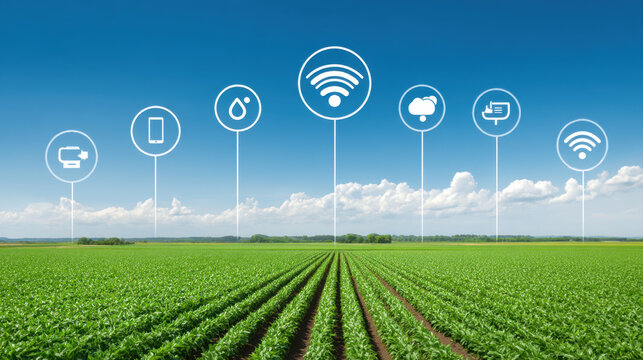
NASACI Wireless sensor networks for agriculture are limited networks of small, autonomous sensor nodes that are distributed along agricultural plantations of soya beans, chia seeds, and other crops to monitor environmental and physical conditions of fertile soils. These sensors transmit soil condition data to a gateway, most commonly a microwave central tower, which in turn sends the signal and logical information to Azure for data processing.

Wi-Fi and microwave signals do not require cabling and are highly scalable. A local Internet service provider is required. NASACI can procure Internet services by providing governments and regulatory agencies with the corresponding RF licenses to operate as such.

The network has the following principal hardware distribution, not limited to logical intelligence:

  • Sensor nodes: These are individual, small, and low-power devices placed along agricultural fields that collect data from their surroundings, including temperature, humidity, nutrients, detection of certain pests, or even motion.
  • Wireless communication: Wi-Fi terminals and microwave nodes communicate wirelessly with each other, often forwarding the required information through multiple hops to a central hub, and further sending it to Azure Cloud or to a central NASACI server for processing and analysis to generate results for agricultural workers and farm administrators using servers, laptops, or PCs.
  • Gateway: Most commonly a microwave link where the information data eventually reaches a central gateway (server, PC, laptop, Android tablet), which connects to the Internet for further processing and analysis as a normal application.
CONFIGURABLE APPS
  • Environmental monitoring: Environmental monitoring: Tracking temperature, humidity, pollution levels, and soil nutrients; if needed or requested, monitoring floods, fires, or other disasters.
  • Practical agricultural systems.
  • Scalability: NASACI sensor networks can be expanded by adding more sensor nodes.
  • Flexibility: Sensors can be placed in hard-to-reach areas, underneath agricultural plantations, or on mobile platforms.